

As Students Get Ready to Submit Early, the Media Continues its Hyperfocus on Select Colleges
Every October, a colleague and I speak to a delightful parent group in Northern NJ about admissions and testing issues. It's a very eclectic audience, with many of the parents having been educated outside the United States. How are they supposed to make any sense of our system? How do I explain why the media repeatedly harps on the same colleges and issues (like what's going on at Harvard and what AI means for education)?No, I don't turn to Claude (nor have I ever). This year, I screenshot a bunch of Instagram posts. My message: block out the noise. Focus on what your student wants and needs. Form your own impressions, separating your student's situation from those highlighted in the media. Understand that there's a lack of transparency in our system, but with good guidance and research, it always works out.October is a month of transition - cooler temps, Early submissions and hopefully some clarity. Let's see what's going on.
🎃 🎃 🎃 🎃
Countering the STEM Tide: We're All In!
Recently, Wall Street Journal author Callum Borchers asked executives, academics and investors what students should study in college. An investor responded that "your time and money are best spent on studies that force you to think critically and understand people because those abilities can help you adapt to change." His recommendation: study anthropology!
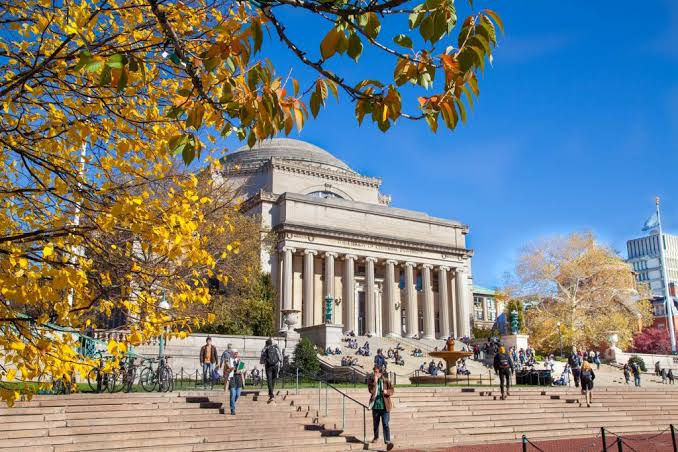
Then there's a recent announcement from Columbia: In 2027, journalism will come roaring back. While Columbia's graduate journalism has always been stellar, it's been a while - 90 years - since they offered a program for undergrads. The new version will emphasize foundational skills, newsworthy topics and alternative media (e.g., podcasts). As noted in the Columbia Spectator, students enrolled in the program will still need to select another Columbia major until the university deems that journalism can stand on its own.
Anthropology and journalism: they're so very contrary to the business and STEM tide. Inside Higher Ed shared that the number of humanities degrees awarded dropped some 12.7 percent between 2021 and 2023. The most popular major - shock - is business with 1.6 million majors, followed by engineering with 1.2 million. But do students really need a deep business major? What really matters in their careers that they can take from their college experience? Now, that's debatable!
🍁 🍁 🍁 🍁
Megadosing on Harvard. Why All the Fuss?
As a reader of this blog, you know about my cynicism surrounding categories like Ivy Plus, Public Ivies or Small Ivies. Recently. the Chronicle attempted to provide some perspective around the media's infatuation with the Crimson. Notes author Karin Fischer, "Experts acknowledge that the Harvards of the world, after all, do set the research agenda, do educate the world’s leaders, do produce critical knowledge." Harvard and peers are embedded in our culture; political leaders attended the institutions. Still, comments Fischer, "kerfuffles over As and standardized-test scores can contribute to the sense that colleges are elitist, out of touch, and charging an arm and a leg for worthless degrees."
🎃 🎃 🎃 🎃
College Alternatives: Will They Stick?
We get it: colleges cost a fortune, and students have to make decisions when they don't really know what's going to change. Starting in 2027, there will be a yet another alternative model, this launched by founders of Anthropic, Nvidia, Meta and Open AI and funded with $35 million by venture firm Andreessen. As reported in the Journal, the venture, which will be called the Horowitz Andreessen Academy, will start as a yearlong program, then hopefully become two years. The article explains that "students will spend up to 80% of their time on project-based learning such as building an AI model, creating a product or interviewing industry experts. Attendees of the academy will also have the opportunity to participate in 'co-ops'—essentially internships—with founding partners." No teaching credentials for these instructors!
🍁 🍁 🍁 🍁
Nurture the Human Side: the Antidote to AI
As reported in the WSJ, Cornell just issued a 200-page report on the challenges facing higher education. Among the needs to be addressed include "developing Cornell students’ soft skills and giving them experiential-learning opportunities." They mention what every college student should do to be career-ready, specifically, coops, group projects and internships.

Earlier in the year, Yale issued a report that stated, "Yale University’s mission is to create, disseminate, and preserve knowledge through research and teaching.” Let's see how Cornell's more practical and detailed initiatives serve the institution.
🎃 🎃 🎃 🎃
Southern Charm Revisited
Town & Country can put together some awfully interesting pieces about Southern colleges. So it was no surprise when they profiled Southern Methodist University, another name that occasionally gets raised here in the Northeast. Calling it "the best little university in Texas," T&C explains that SMU is drawing heavily from all types of students as a result of need- and merit-based aid; its sticker price is over $96,000. It notes three states that are sending students there in great numbers: NJ, NY and CT! The article described the university's "focus on careerism," with a typical student “cramming for a strategic cost analysis exam before heading off to a frat party.”

🍁 🍁 🍁 🍁
Penn Tells Students: Do the Math!
Earlier this year, declining math skills prompted UC professors to call for reinstating standardized tests. (UC is test-blind, meaning they can't be considered in admissions.) While Penn has always had tough prerequisites for particular calculus and algebra courses, they've left it to up to students to make sure they have the appropriate background.
No more! Now Penn will review students' credentials before allowing them in math classes. In a message to Inside Higher Ed, a deputy dean in the College of Arts & Sciences stated, “Faculty in Math and other disciplines have carefully designed the courses in a sequential manner to support student learning. Students who are in courses that they are not adequately prepared for can often run into challenges.”

🎃 🎃 🎃 🎃
UF: A Force in AI Education?
The University of Florida is very popular with Northeast students, but not necessarily because of its AI prowess. In a CNN release, we learn that UF has been teaching AI since 2022. States provost Joseph Glover, "We don’t think it’s appropriate or useful to relegate (AI education) to the computer science department or the College of Engineering." Apparently, UF had its early start thanks to backing from alum Chris Malachowsky, who cofounded Nvidia along with Jensen Huang. According to the article, UF has some 200 courses across a variety of departments for both faculty and students while offering AI certificates for hospitality and public health students.
🍁 🍁 🍁 🍁
How Canadians Look at Information
While we don't know how the fuss over AI will shake out, we are liking a new program from the mighty University of Toronto. They call it a Bachelor of Information (BI), and it's interdisciplinary. In four carefully mapped-out years, students will explore the interaction between humanities, social sciences, computer science and design as they "approach complex challenges from multiple perspectives." UT had a two-year program, and this expansion allows for experiential learning and extensive background on the quantitative side, starting with computational thinking and moving through to topics such as data analytics, organizational theory to a full-year capstone. A win!
🎃 🎃 🎃 🎃
Reach for the STARS? It Depends.
If your student is complaining about STARS, you'll want to pay attention here. It's a system used largely by public research universities. Once they apply, students have to self-report their entire high school transcript. For assistance, take a look at the description and instructions on the U Delaware site. Why do some universities use STARS when your student's counselor is also sending a transcript? Apparently, they've found it faster than waiting for individual transmissions.
🍁 🍁 🍁 🍁
In our meetings, I will continue to provide thoughtful responses to your questions and guide your student in a way that helps them discover and support their interests - before and during the college process. That's what I'll emphasize in the upcoming session for Northern NJ parents. Hopefully, they'll be able to grasp the importance of solutions geared toward their child, not some hypothetical in the media. For more, be sure to stay in touch and see how the unCommon way will enable you and your student to maximize opportunities in this process.

Comments